Beyond Mendoza: Patagonia's Cool-Climate Wines, Top Producers, and How It Compares to Mendoza and Argentina's High-Altitude North
Argentina's wine story doesn't end in Mendoza. Head south to Patagonia or north to the Andean highlands of Salta and Jujuy, and you'll discover two of the most exciting — and contrasting — wine frontiers on Earth. This guide breaks down the producers, the grapes, and the terroir that make each region unique.
Argentina's Wine Map Is Bigger Than You Think
When most wine lovers think of Argentine wine, Mendoza comes to mind first — and for good reason. It's the engine of the country's wine industry, responsible for the majority of its exports and the global rise of Malbec. But limiting Argentina to Mendoza alone is like limiting France to Bordeaux.
To the south, Patagonia stretches into wind-battered latitudes where vines struggle — and thrive — under extreme conditions. To the north, the high-altitude valleys of Salta, Jujuy, and Catamarca produce wines of almost otherworldly intensity at elevations that leave visitors breathless. And between them, Mendoza holds its classic ground.
These are not interchangeable. They are three distinct wine philosophies shaped by geography, climate, and the producers brave enough to farm them.
Patagonia: Argentina's Cool-Climate Frontier
Where It Is and Why It Matters
Patagonia's wine country lies roughly between 38° and 46° south latitude — among the southernmost wine-producing zones on the planet. The main regions are Neuquén (centered around San Patricio del Chañar), Río Negro (the Alto Valle), and the emerging frontier of Chubut, home to some of the world's most southerly commercial vineyards.
What defines Patagonia is not altitude — the vineyards here sit at relatively modest elevations — but latitude and climate. Long summer days with intense ultraviolet radiation. Cold nights that preserve natural acidity. And the wind. Always the wind.
The Patagonian Wind: A Winemaker's Challenge and Secret Weapon
The zonda and Patagonian winds are constant, powerful, and relentless. For farmers, this is both curse and gift. On one hand, wind stress forces the vine to work harder, producing smaller berries with thicker skins. Thicker skins mean more color, more tannin, more polyphenols — complexity without the need for extreme heat. On the other hand, excessive wind can damage flowering and reduce yields dramatically.
The result is wines of surprising structure and elegance at moderate alcohol levels — typically 13–14% ABV — compared to the richer, warmer-climate styles of Mendoza.
The Star Grapes of Patagonia
Pinot Noir is Patagonia's crown jewel. In regions like Río Negro, it achieves a transparency and aromatic finesse that draws comparisons to Burgundy or Oregon's Willamette Valley. Cool nights slow ripening, developing red cherry, pomegranate, and dried rose petal notes with vibrant acidity that makes the wines genuinely age-worthy.
Malbec takes on a different personality here. Cooler conditions produce a more floral, firm, and structured expression — less about plush velvet, more about silk and precision. If Mendoza Malbec is a rich opera, Patagonian Malbec is chamber music.
Merlot finds an elegant balance in Patagonia that can be elusive elsewhere. The moderate climate prevents over-ripening, keeping the grape fresh and structured.
Whites are a growing strength: Chardonnay with bright citrus and mineral tension, Sauvignon Blanc with green herb and grapefruit precision, and — uniquely — old-vine Semillón in Río Negro, one of Argentina's most underappreciated white varieties.
Top Producers to Know
Bodega Chacra (Río Negro) — Founded with biodynamic principles and old Pinot Noir vines planted in 1932 and 1955, Chacra produces some of the most sought-after Patagonian wines internationally. Their Cincuenta y Cinco and Treinta y Dos are benchmark expressions of Argentine Pinot Noir.
Noemía (Río Negro) — Born from a partnership between Danish collector Hans Vinding-Diers and Countess Noemi Marone Cinzano, this tiny estate focuses on old-vine Malbec from Río Negro. The wines are precise, mineral, and nothing like what most people expect from the grape.
Familia Schroeder (Neuquén) — One of the pioneering estates of San Patricio del Chañar, producing a full range from accessible everyday wines to serious reserves, with strong Pinot Noir and Malbec expressions.
Bodega del Fin del Mundo (Neuquén) — The name means "Winery at the End of the World," and it delivers on the promise. A large, modern producer making consistent, internationally focused wines across multiple varieties.
Otronia (Chubut) — Located in the 45th parallel south, this estate pushes the boundaries of where wine can be made. Their Pinot Noir and Chardonnay from Sarmiento are genuine pioneers of the "extreme south."
Casa Yagüe (Trevelin, Chubut) — A small family winery in the foothills of the Andes near the Chilean border, producing vibrant whites and Pinot Noir at the edge of viticultural possibility.
🍷 Ready to explore Patagonia's vineyards in person? Discover small-group wine tours across Patagonia's top estates — with expert local guides, tastings included. 👉 Browse Patagonia Wine Experiences on Viator
Mendoza: The Classic Heart of Argentine Wine
The Benchmark Region
Mendoza needs little introduction, but context matters. Sitting between 32° and 35° south latitude at the foot of the Andes, it combines altitude (most vineyards sit between 700m and 1,200m), desert climate, and Andean snowmelt irrigation to produce wines of concentration, power, and warmth.
The amplitude between day and night temperatures — often 15–20°C — preserves aromatics while allowing full phenolic ripeness. The result is the classic Argentine profile: generous dark fruit, velvety tannins, and impressive structure.
Mendoza's Key Sub-Regions
Luján de Cuyo: The historical heartland of Argentine Malbec, with gravelly soils and established old vines.
Valle de Uco: The rising star — higher elevations (up to 1,500m), cooler temperatures, and soils rich in limestone and alluvial deposits. Sub-zones like Gualtallary and Paraje Altamira are producing some of Argentina's most exciting wines.
Maipú: Warm and productive, home to many classic Malbec producers.
Elevations range from 1,700m to over 3,300m above sea level — the highest in the world for commercial wine production.
🍷 Planning a trip to Mendoza? From half-day tastings to full Uco Valley tours — find the best Mendoza wine experiences with free cancellation. 👉 Browse Mendoza Wine Tours on Viator
What Extreme Altitude Does to Wine
At these elevations, ultraviolet radiation is intense, oxygen is thin, and temperatures can swing dramatically — blazing afternoons followed by near-freezing nights. This extreme thermic amplitude forces grapes to develop extraordinarily thick skins packed with pigments, aromatics, and protective compounds.
The resulting wines are deeply colored, aromatically explosive, and high in natural acidity despite the heat of the day. They can be simultaneously powerful and fresh — a paradox that confounds expectations.
The Star Grapes of the NOA
Torrontés is Argentina's most distinctive white grape, and Cafayate is its spiritual home. At altitude, it produces a wine of exceptional aromatic intensity — jasmine, white peach, rose petal, and apricot — with a crisp, dry finish that surprises those expecting sweetness. It's one of South America's great original white wines.
Malbec at altitude in Salta is a different beast entirely. Smaller berries, more concentrated color, wilder aromatics — spice, violet, dark fruit, and an almost ink-like depth. Producers like Clos de los Siete and Achaval Ferrer have shown the world what high-altitude Malbec can do.
Cabernet Sauvignon also performs well at altitude, producing structured, herbaceous wines with dark fruit and firm tannins.
Top Producers to Know
Bodega Colomé (Salta) — Swiss hotelier Donald Hess purchased this historic estate in the Calchaquí Valleys, home to vines planted in the 1800s at over 2,000m. Their Altura Máxima Malbec, from the highest vineyard at 3,111m, is a collectors' wine of global stature.
El Esteco (Cafayate) — One of the oldest and most respected wineries in the north, producing a wide range including benchmark Torrontés and structured reds.
Bodega Clos de los Siete (Mendoza/Uco, with high-altitude philosophy) — While based in Mendoza, the project brings together several French investors and embodies the altitude-driven philosophy of modern Argentine winemaking.
Tacuil (Salta) — A tiny, artisanal producer at 2,000m+ in the Calchaquí Valleys, making just a few thousand bottles per year of some of the most mineral and intense wines in Argentina.
Amalaya (Salta) — The accessible face of Colomé, offering approachable, beautifully made wines at reasonable prices for the international market.
🍷 Curious about Argentina's high-altitude wine country? Explore Salta and Cafayate with guided tours that take you into the Calchaquí Valleys and beyond. 👉 Browse Salta Wine Tours on Viator
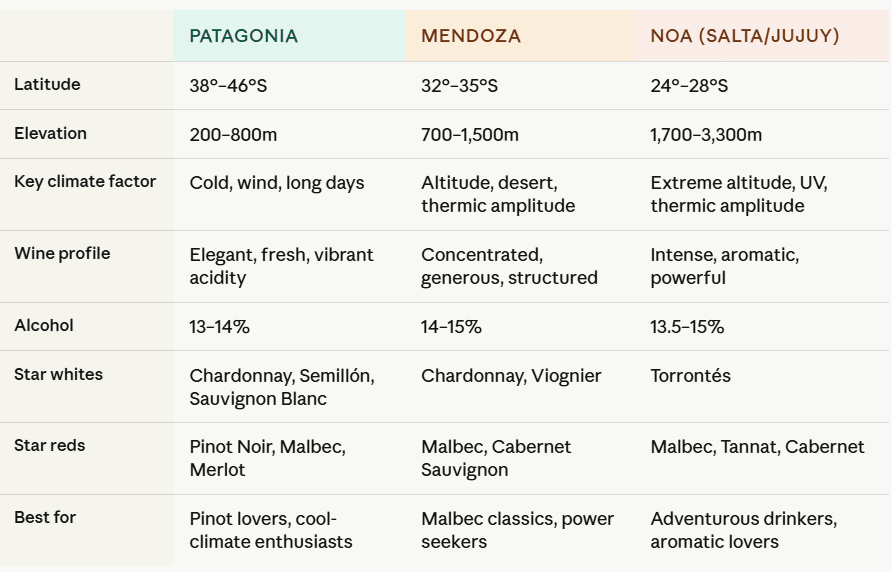
TERROIR COMPARISON:PATAGONIA vs. MENDOZA vs. NOA
Which Argentine Wine Region Should You Explore?
There's no wrong answer — but there is a right starting point depending on your palate:
If you love Burgundy or Oregon Pinot Noir, start with Patagonia. Chacra's Cincuenta y Cinco will change how you think about Argentine wine.
If you're a Malbec devotee, Mendoza is your foundation — then graduate to a Valle de Uco or a Noemía from Río Negro for contrast.
If you crave something totally unlike anything else, seek out a Torrontés from Cafayate or a Colomé Altura Máxima. These wines don't exist anywhere else on Earth.
Final Thoughts
Argentina's wine country is one of the most geographically dramatic in the world. From the windswept southern latitudes of Patagonia to the thin-aired Andean peaks of Salta, the country offers a spectrum of styles, grapes, and terroirs that rival the diversity of any major wine nation.
The global wine conversation is just beginning to catch up. The producers listed in this guide are not emerging curiosities — they are serious, internationally acclaimed estates making wines that deserve a place on any serious wine list.
The question isn't whether to explore Argentine wine beyond Mendoza. The question is where to start.
Explore more about Argentine wines, regions, and producers at vinosargentinos.com